Posts

Review: An education in forgotten horrors

Image
THE FORGOTTEN HORRORS READER, by Michael H. Price, with George E. Turner and Christina Renteria Price. Lower Klopstokia: Cremo Studios, 2017. 364 pages. $30. The FORGOTTEN HORRORS franchise started by Michael H. Price and George E. Turner with the publication of the original FH study in 1979 continues today as it marches through the 1960s with honest, informed and fascinating criticism of low-budget chillers and their appeal to moviegoers. A recent offshoot from the work of Price and Turner have been collections of essays, criticism and history of movies that may not have fallen into the FH category but have enough similarity to be considered part of the family. Among these are FORGOTTEN HORRORS TO THE Nth DEGREE: DISPATCHES FROM A COLLAPSING GENRE (with John Wooley, 2013) which took a fun and absorbing look at product that used to haunt drive-ins from the '60s until the '80s, then found a later life on local TV, videotape and digital forms of home entertainment. Such st...
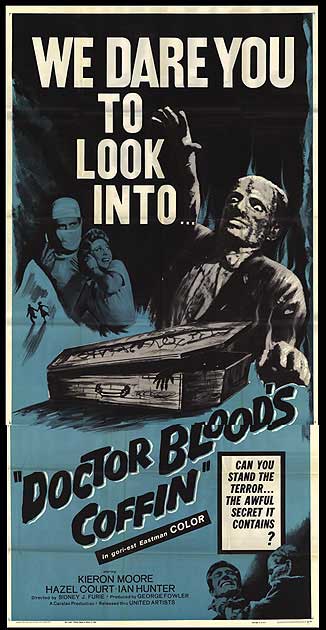
Horror in broad daylight: 'Doctor Blood's Coffin'

Image
Produced at a time when the movie horror market was dominated by the works of Britain's Hammer Films and Roger Corman's stylish Edgar Allan Poe adaptations, DOCTOR BLOOD'S COFFIN (1961) is a standout for its vivid use of location and updating of Mary Shelley's FRANKENSTEIN. The 91-minute film shot in color plays out its Gothic horrors against an unsuspecting rural community and sun-splashed atmosphere that lends a high contrast to the evil that lunges from the darkness. The relationship between the film's protagonist, Dr. Peter Blood (Kieron Moore) and Victor Frankenstein is evident since both young men are convinced their individual brilliance as surgeons has destined them to do something great -- namely, bring life to the dead. And no matter how much common sense and opposition are hurled at them, they are set on a course of achieving their dream, even if it costs the lives of other people. The difference posed by DOCTOR BLOOD'S COFFIN with the Shelley orig...

Turning Poe's mystery tales into movies

Image
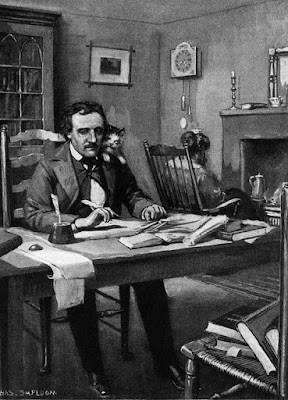
Though notoriously difficult to translate into workable screenplays, the works of Edgar Allan Poe (1809-1849) have provided Hollywood and international filmmakers with a fertile source of story material. Be it his fiction or such poetic classics as "The Raven" (1845), Poe's works continue to inspire filmic imagery with a basis in the themes and ideas the author explored during his hectic career as one of America's first literary giants. Best known as one of initial and uniquely American fantasists and creator of horrors, as in "The Tell Tale Heart" and "The Black Cat" (both published in 1843), Poe is also recognized as the creator of modern detective fiction, the well-spring of deductive reasoning as the solution to murder and crime puzzles later expanded upon by Sir Arthur Conan Doyle and his creation, Sherlock Holmes. For much of C. Auguste Dupin, Poe's occasional Paris-based sleuth whose fame lies in three stories, was worked by Holmes...

What a beautiful time for homicide

Image
So why do mystery writers -- for print, the screen and television -- choose the Christmas holidays as an ideal time for murder? Perhaps the most obvious answer lies in the setting of a time of peace and good will toward all men (and women), where finding a body buried in the snow or under a traditionally decorated tree is completely at odds with everything that is Christmas. Because the end-of-the-year holidays also provide a legitimate reason for bringing people together, circumstances are ripe for crime, greed, family feuds and all of the ingredients for a motive to mix and mingle and produce a mystery for official and amateur detectives to try their hands at solving. So why not have homicides occur on other occasions such as Valentine's Day, Memorial Day or Labor Day? No doubt some whodunits and crime stories have been played out against such backgrounds, the latter two representing long weekends in which the initial slaying doesn't come to light immediately, muddying th...

Remade, but was it necessary?

Image
Perhaps apropos of nothing -- which is what I say when I'm about to discuss something of little or no importance -- I notice that a new version of MURDER ON THE ORIENT EXPRESS will be issued to theaters Nov. 10. Directed by and starring Kenneth Branagh as Agatha Christie's iconic Belgian detective Hercule Poirot, this production promises a "stylish and suspenseful" viewing experience, as proclaimed by its promotional material, and it no doubt will be all it sets out to do. But considering the equally lavish adaptation of "Murder on the Orient Express" that appeared just over four decades ago, was another version of the tale all that necessary? I have a different take on remakes of movies. They generally fascinate me until I see them, and I am left with the conclusion that the original version was better. New ideas introduced into the remake are okay with me, particularly if they show signs of originality or offer another take on what was so excellent abo...

Gothic light: 'The Strange Door'/'The Black Castle'

Image
Often considered the dawn of science fiction in Hollywood, the early 1950s saw that although the classic horror films of the '30s and '40s -- especially those released by Universal Pictures -- were no longer in production, there was still a lingering appreciation of them by audiences. Universal, which became Universal-International in 1946, backed away from the profitable if assembly-line thrillers of recent vintage by shutting down its second feature and serial units to concentrate on bigger movies. However, response to its pairing of moneymaking comics Bud Abbott and Lou Costello with the studio's most famous monsters in ABBOTT & COSTELLO MEET FRANKENSTEIN (1948) was such that executives took notice, and rightfully so. A&C MEET FRANKENSTEIN generated as many chills as laughs and offered some heightened production value to patrons, prompting some speculation that a revival of movies featuring the Frankenstein Monster, Count Dracula and the Wolf Man was in the ...