Posts

Image
          'I've got to get it out of me!': THE MANSTER (1959) Dripping with eerie atmosphere, the U.S.-Japanese co-production THE MANSTER is one of those horror films of the late 1950s and early '60s that lingers in the memory long after its initial viewing. It not only contains one champion of a shock scene -- so effective it's been copied in at least one later movie -- but an overall sense of unease while watching that can't easily be lost as the closing reel ends. THE MANSTER is upfront with its horrors, as were such other models of mounting dread from the period as THE MONSTER FROM PIEDRAS BLANCAS (1961), THE BRAIN THAT WOULDN'T DIE (1962) and the Japanese product MATANGO/ATTACK OF THE MUSHROOM PEOPLE (1963). Once the stage has been set for something terrifying to make its appearance, THE MANSTER delivers, and while its titular creature of terror may appear hokey today, its revelation is a nicely orchestrated moment of fright for its unsuspecting ...
Image
This is the Inner Sanctum...' Ever in search of movie series material, Universal Pictures' launch of the "Inner Sanctum" programmers in late 1943 held the promise of being more than just whodunits designed to keep star player Lon Chaney Jr. occupied in between assignments as the studio's great monsters. With an emphasis on interior conflict faced by the protagonist in each of the series' six entries, the Inner Sanctums boded well as a potential competitor to the classier Val Lewton-produced horror films from RKO Radio Pictures. But as pointed out by John Brunas, Michael Brunas and Tom Weaver in their exhaustive UNIVERSAL HORRORS: THE STUDIO'S CLASSIC FILMS 1931-46 (Jefferson, N.C.: McFarland & Co., 1990, pp. 393-394), Universal's tight-fisted approach to the Inner Sanctums doomed them to be, to put it charitably, missed opportunities, or in the view of others, an outright waste of time; "feebly conceived," as the Brunases and Weaver o...

Playing at your local drive-in: The films of Richard Bernstein

Image
When Wyott Ordung put together what became his magnum opus of independent filmmaking, the eccentric but interesting WALK THE DARK STREET (1956), he had some help in the form of two associate producers on the project, Tom Michaels and Richard Bernstein. WALK THE DARK STREET is, according to the IMDB, Michaels' only movie credit, but Bernstein built upon the experience to launch a brief but involving career as a writer-producer, climaxing with two 1960s releases in the popular fields of horror and westerns, TERRIFIED and THE GUN HAWK. Since an earlier and much lengthier blog of mine focused on Ordung (1922-2005), his career as an actor, writer, producer and director, it occurred to me, as I stumbled onto his name on other films, that Bernstein's contributions were rather interesting. While Ordung boasted only a few more credits after WALK THE DARK STREET, Bernstein was busier, even if his Hollywood career closed as quickly as his collaborator's. Bernstein (1922-1983) r...

A mini- tribute to Edgar Wallace Mystery Theater

Image
              A mini-tribute to Edgar Wallace Mystery Theater Edgar Wallace (1875-1932) wrote scads of mystery and crime novels and short stories in addition to plays that were ripe for adaptation by the movies. In fact, the British author, who had relocated to the U.S. in 1931, was working on an initial draft of the script for KING KONG (1933) at the time of his untimely death from undiagnosed diabetes. His works were increasingly turned into cinematic product in the years following his death, including his early African adventure work SANDERS OF THE RIVER, which Universal filmed in 1934 with Colin Clive in the lead. He was well-represented in his homeland's film industry with such entries as THE RINGER (1931), its remake THE GAUNT STRANGER (1939), THE TERROR (1938) and THE CASE OF THE FRIGHTENED LADY (1940).  Reprinting of Wallace's novels and stories in West Germany in the late 1950s inspired a flood of "krimi" pictures based -- in some...

More thoughts on Gangsters Galore

Image
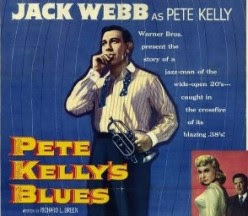
More thoughts on Gangsters Galore A couple of winters ago I wrote for Turner Classic Movies' Community Forum a set of three blogs on "Gangsters Galore," a highly informal survey of films and TV shows about movies dealing with the bad old days of 1920s and '30s criminals that developed into a multi-year fad with audiences. This period extended from late 1957 with the release of the independently-made BABY FACE NELSON to the last episode of THE UNTOUCHABLES in the spring of 1963. Its popularity was based in part on exposes of organized crime throughout the '50s that probed the historical roots of racketeering that came to form the back stories of AL CAPONE (1959) and MURDER INC. (1960), and a fascination with the outlaw element of the Dillinger-type crime sprees that terrorized the nation's southwest and mid-section during 1933-1934. The latter inspired a series of biopics, such as Roger Corman's MACHINE GUN KELLY (1958) and PORTRAIT OF A MOBSTER (1961),...

Pre-Code and loving it: The World Gone Mad (1933)

Image
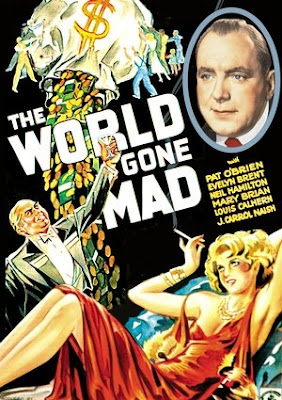
Pre-Code and loving it: The World Gone Mad (1933) Prior to the strict oversight and enforcement of the Production Code on the content of Hollywood films in 1934, producers' approach to modern mores, sex, crime and other aspects of contemporary life was fairly free-wheeling, not simply salacious for the heck of it (these movies still had to play in Peoria, so to speak) but a recognition of the adult understanding of the Depression-era movie audience. People went to the movies for escapism, but accepted contemporary concerns as part of the viewing experience; the reality-based movies produced by Warner Bros. such as I AM A FUGITIVE FROM A CHAIN GANG, WILD BOYS OF THE ROAD and HEROES FOR SALE (1932-1933) were popular because they were about issues and social problems seen in the newspapers. With them came a certain frank appreciation of human behavior, from social attitudes to even profanity, the latter not overdone but still there and usually limited to "damn." In a way...